Atlas / Oceania - Australia
Aboriginal Australia: Many Nations
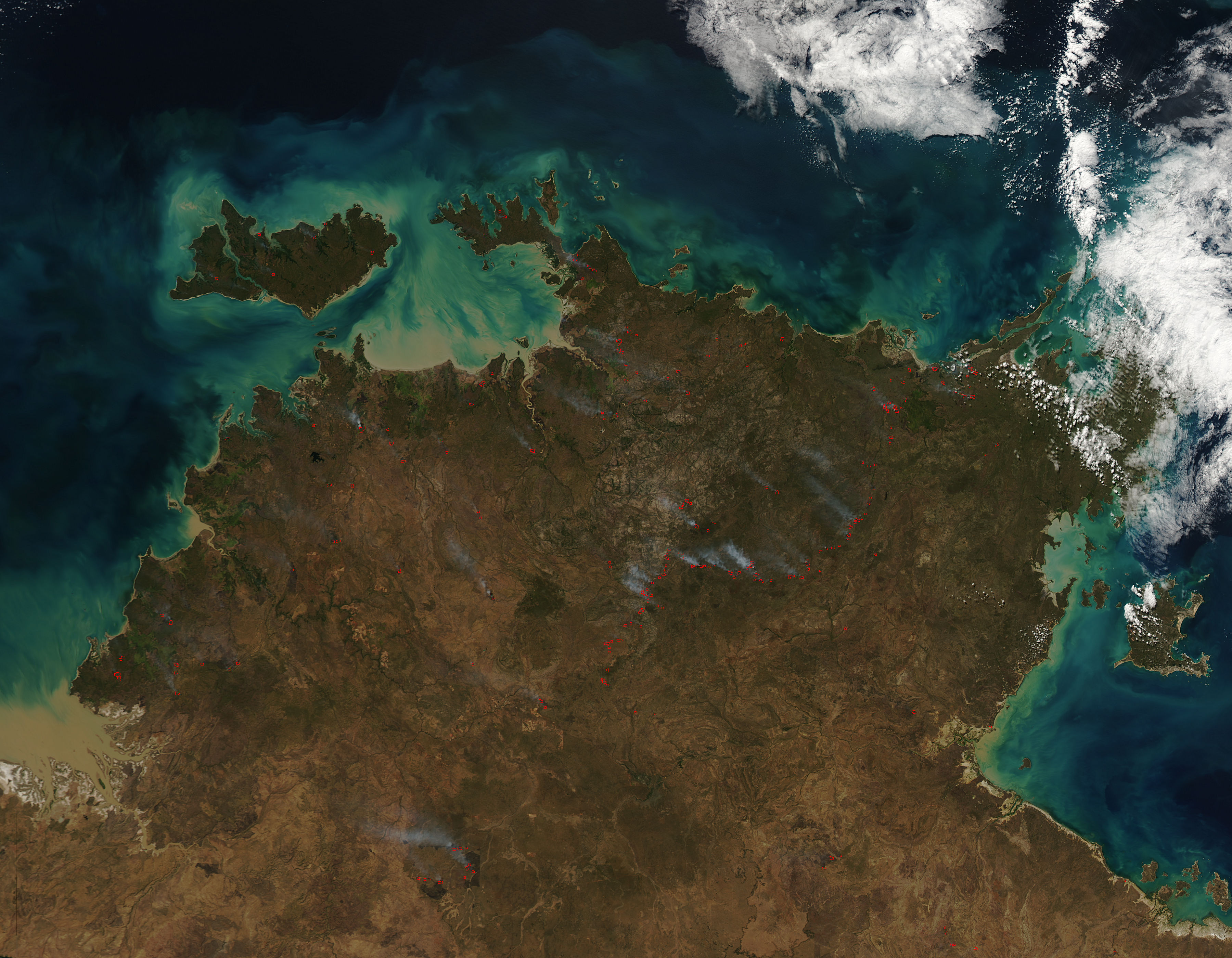
Header image: Fires across Arnhem Land, Northern Territory, seen by the MODIS satellite, July 2015 - the dry-season burning mosaic visible from orbit - Jeff Schmaltz, MODIS Land Rapid Response Team, NASA GSFC, Public domain

A documented history
Aboriginal peoples have lived on the Australian continent for more than 60,000 years - the longest continuous cultural history on Earth. British colonization from 1788 declared the continent terra nullius, empty land belonging to no one, and took it without treaty. The University of Newcastle's Colonial Frontier Massacres project documents mass killing sites across the continent between 1788 and 1930 - the violence was not incidental to settlement; it was the method.
The twentieth century added the policies now known together as the Stolen Generations: Aboriginal children removed from their families by the state to be raised apart from their languages and law. Australia formally apologized in 2008. The legal doctrine of terra nullius was overturned only in 1992, when the High Court's Mabo decision recognized native title for the first time.
- 60,000+ yearsAboriginal peoples live on and manage the Australian continent - the oldest continuous cultures on Earth.
- 1788British colonization begins under the doctrine of terra nullius; the land is taken without treaty or consent.
- 1788-1930Frontier massacres across the continent - mapped by the University of Newcastle project.
- 20th centuryThe Stolen Generations: Aboriginal children systematically removed from their families.
- 1992The High Court's Mabo decision overturns terra nullius and recognizes native title.
- 2008The Australian Parliament formally apologizes to the Stolen Generations.
- 2019-20Megafires burn through unmanaged forests; cultural burning returns to national attention.
- 2023Australians vote No in the referendum on a constitutional Indigenous Voice to Parliament.
A way of knowing
Tyson Yunkaporta (Apalech clan, Western Cape York) opens Sand Talk by describing himself as 'a boy who belongs to the Apalech clan from Western Cape York, a Wik Mungkan speaker' - and then shows what that means: a way of thinking built on relation, pattern and yarning rather than hierarchy and abstraction. 'Beings of higher intelligence are already here, always have been,' he writes. 'They just haven't used their intelligence to destroy anything yet.'
Victor Steffensen (Tagalaka) carries fire. In Fire Country he records what his elders taught him: reading the land for the right day, the right wind, the right patch - cool, slow burns that clean country, feed it and prevent catastrophe. The 2019-20 megafires, burning forests that had not been managed for generations, made the cost of suppressing that knowledge visible to the whole world.
And beneath both lies the songline: routes of sung knowledge that map the continent, encode law, water, food and obligation, and make memory walkable. Margo Neale, senior Indigenous curator at the National Museum of Australia, calls them corridors of knowledge.
A living nation
Native title now covers large parts of the continent; Indigenous ranger programs manage country on a scale no state agency can; and cultural burning has returned to official practice, with Aboriginal fire practitioners advising fire services after the 2019-20 catastrophe.
The gaps remain stark: no treaty at the federal level, a rejected 2023 referendum on a constitutional Voice to Parliament, and continuing struggles over mining on Aboriginal land. But the direction of the knowledge traffic has reversed - the country is now learning from the people who managed it longest.
Reading
Sand Talk: How Indigenous Thinking Can Save the World
Aboriginal thinking on its own terms - relation, pattern, yarning - with the author's own protocols kept visibly in place: he tells you what he cannot tell you. Quotes here are from the publisher's official chapter sample.
Fire Country: How Indigenous Fire Management Could Help Save Australia
The practitioner's account: what reading country for fire actually involves, and what two centuries of suppression cost.
Songlines: The Power and Promise
Songlines as knowledge infrastructure, from the National Museum of Australia's senior Indigenous curator.
Sources
- Colonial Frontier Massacres map, University of Newcastle
- Text Publishing: Sand Talk (with official chapter sample)
- AustLit: Tyson Yunkaporta author record
- Thames & Hudson: Songlines (First Knowledges series)
- Fire Country (Hardie Grant, 2020)